
Why Is Your Website Suddenly Becoming Invisible for Buyers?
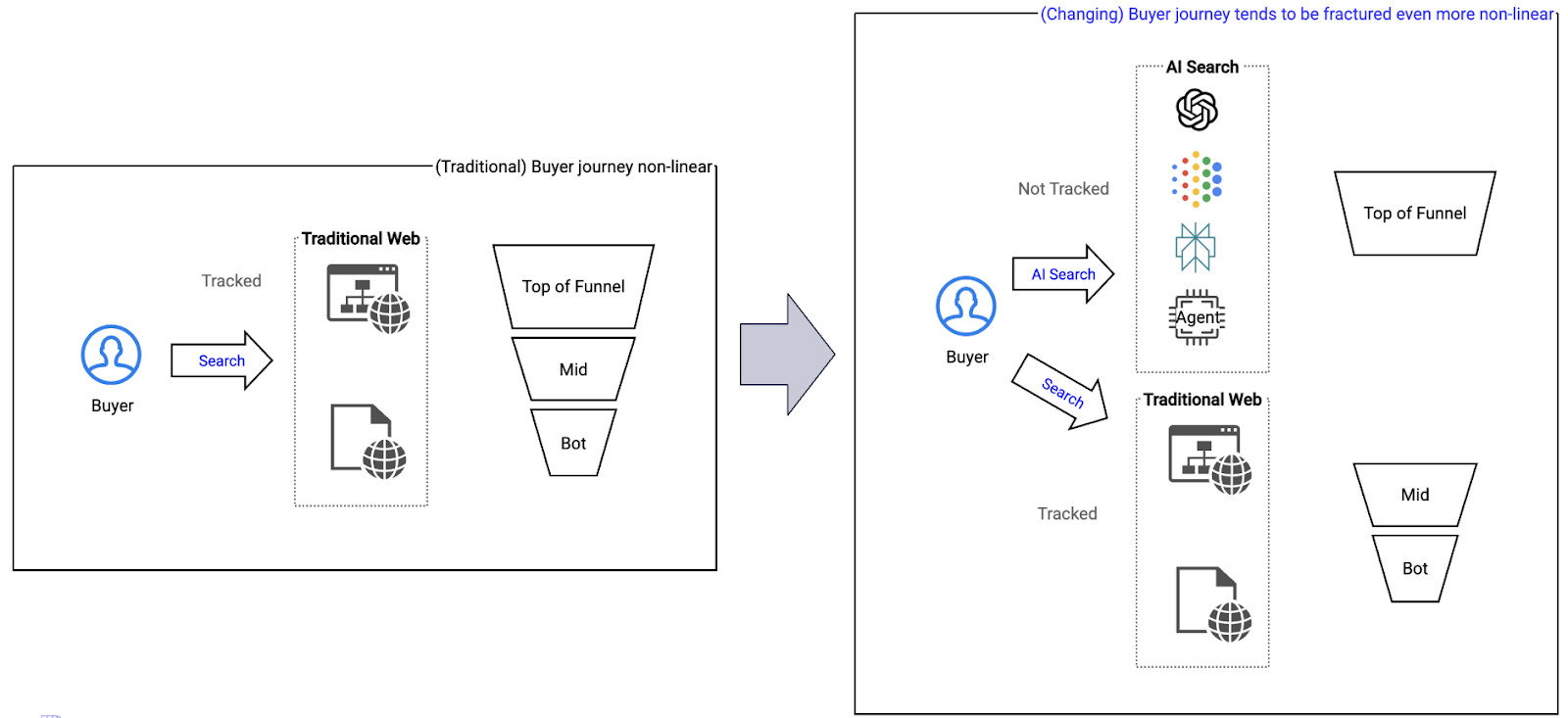
A subtle yet fundamental shift is quietly transforming the B2B buying landscape, altering how organizations engage with prospective buyers and redefining the buyer journey. The proliferation of LLM-based AI search engines such as Claude, Perplexity, and ChatGPT has shifted expectations toward rapid, precise responses rather than mere lists of blue links. These function as AI Answer Engines, providing summarized, relevant information directly to business users. Consequently, traditional website traffic, particularly from top-of-funnel prospects, diminishes as many queries are addressed by these AI solutions prior to engagement with vendor websites or intermediary agents.
This evolution challenges established B2B buyer journeys and calls for a new playbook: one that elevates your site from “search-found” to “AI answerable”. Enter AI Search Optimization with AEO (Answer Engine Optimization) and GEO (Gen-AI Engine Optimization).
Why does AI Search Optimization matter now?
SEO was about making content discoverable by humans, whereas now, we also need to make web content discoverable by AI Search and other agents. Not only that, it should be citable by them (see Reference-1 for details). It is all about making your website content optimized for AI Search.
Here are some key Trends:
- AI search traffic is growing, although it represents a small portion of overall traffic. However, this AI-driven portion is experiencing explosive growth.
- Zero-click searches are becoming the norm. Users increasingly get the information they need from AI-generated summaries and snippets, reducing the need to visit external websites.
- AI Overviews prioritize authoritative and trustworthy content, even if it doesn’t rank at the very top of traditional search results.
- Conversational search is on the rise. Users are increasingly asking longer, more complex questions, mirroring human conversation. This is driving the development of AI-powered search features like Google’s AI Mode. (What used to be 2 word-searches now is getting into 23-word searches implying long tail, specific queries from buyers)
Since the dynamics are changing fast, we propose a short-term general solution, which is quick to implement and then a long-term specific solution, which is evolving, and that involves human collaboration. This article focuses on the short-term general solution.
Here is how the buyer dynamics are changing.
How do I get discovered? – For the short term
In the short term, your digital presence must go beyond standard SEO and also be discoverable. Your web properties – especially authority TOFU pages, FAQs, and decision-support content – should be restructured and sometimes even rephrased to be easily discoverable and quotable by AI engines. This requires crafting content that aligns with both search intent and answer formats. Your website traffic will tend to decrease, but chances are that it will have high intent, so regular buyer agents like ChatFactory will be helpful.
Tackling fractured buyer journeys – for the long term
Longer-term strategies are still unfolding, but have more to do with preserving engagement within fractured buyer journeys. This will also involve lighting up the (prior) engagement from AI search.
AI Search Optimization
The entire site needs to be optimized for AI Search. It rests on these foundations.
On-Page Optimization (Your Web Pages): Building Cited Content
- Technical Foundations:
- Ensure content is indexable.
- Implement Schema Markup.
- Utilize responsive design.
- Include site breadcrumbs.
- Optimize for fast loading speed.
- Content Strategy:
- Prioritize topics that are already attracting citations.
- Structure content logically for clarity and readability.
II. Off-Page Optimization: Promoting Authority
- Gaining Citations:
- Source citations from video platforms (e.g., YouTube, Vimeo).
- Engage with community content platforms (e.g., Reddit, Wikipedia, Quora).
- Seek citations from authoritative content, industry publications, and affiliates.
- Brand Presence & Engagement:
- Focus on product and brand mentions.
- Actively participate in relevant online communities.
- Build high-quality backlinks.
- Cross-Channel Consistency:
- Ensure consistent B2B citations across platforms like AI Search, G2, and TechRadar.
III. Technical Considerations for Search Bots
- Bot Accessibility:
- Allow search engine bots to crawl your content.
- Content Freshness:
- Maintain up-to-date web content.
- Promote fresh traffic from other sites (e.g., LinkedIn, Reddit, X).
- User Experience:
- Ensure a responsive design for all devices.
- Optimize for rapid page loading times.
Methodology
- Audit/Baseline: Assess current performance, identify key pages, and plan site-wide or collection-specific adjustments.
- Competitor Analysis: Identify primary competitors.
- AI Search Engine Selection: Choose appropriate AI search engines for the use case (e.g., Gemini, Perplexity, ChatGPT for B2B; Claude for technical use cases).
- Visibility Goals: Determine top areas or topics for desired visibility.
- Content & Site Optimization: Update content metadata and the website.
Partnering with PathFactory
PathFactory’s text-conversational AI pipelines can be leveraged to select relevant content, generate rich metadata and help in visibility goals. It can enable robust FAQ and QA sections making your web assets AEO and GEO ready before AI search engines even crawl them. Beyond just discoverability, it enables:
- Autonomous query generation of content for Q&A
- Seamless integration with buyer identification and personalization journeys
- AI-driven page summaries and dynamic content intelligence
- Automatic alignment with authority and factual accuracy standards
Conclusion: Preparing for the AI-Search Future
To win in today’s B2B digital landscape, brands must make content easily discoverable, answerable, and trustworthy. This is not just for traditional search, but also for the new class of AI answer engines. By embracing AEO and GEO best practices, businesses position themselves to capture, engage, and convert buyers where decisions increasingly begin with AI answer engines.
References: